Archives 2018

Personal Finance – How NOT To Spend Your Money

Welcome back!

This week I am going to go over how NOT to spend your money. There are lots of good things to spend money on, but I continually observe people spending money so they can feel like they are keeping up with the Joneses or because they “deserve” it. And avoid misunderstanding, I am not advocating frugality, just better decision-making when spending money.


Everyday Observations


Bad spending habits observed recently:

Withdraw money from an old 401k account to go on vacation

Spending money to set up a business, but with no initial business activity


Early 401k Withdrawal

If you have money in an old 401k, use it for the intended purpose: Savings for retirement! It is understandable if you have a hardship and need the money to help deal with that, but just pulling the money out to go on vacation is a bit ridiculous. In addition to diminishing the amount of money to be available at retirement, you also have to pay a penalty on the money you withdraw, in addition to taxes at your current rate.


401kEarlyWithdrawal

Amount needed to withdraw from old 401k to get $8000 for a vacation.


As an example, assuming a 24% tax bracket, if you want to use $8000 to go on vacation, you will need to pull out almost $13,000 to cover the $1,290 penalty and approximately $3,097 of taxes to end up with $8000 to go on vacation.

Not only do you lose 34% off of the top of your money, you also loose any additional earnings by not having that total amount of money still invested.


I would like to know more about my readers. If you could spare about 2 minutes of your time, please take a survey to tell me what you like about the blog. Just click here to take the survey.


Setting Up a Business Entity with no Business Activity

I understand the desire to get out of the rat race, to start your own business, and not have to work for someone else. I am right there with you! But take a practical approach. Take a practical approach. I see people starting up LLC entities, putting up websites, and paying for business infrastructure before they have any business activity. That is definitely putting the cart before the horse. If you spend that money, but do nothing in the way of generating business, then that is a wasted expense.

You would do better spending money on actual business-generating activities than paying for infrastructure before you need it.


Suggestions


Vacations

Plan your vacation as inexpensively as possible. Don’t skimp, just don’t pay $1200 a night for a room when you can rent a whole condominium or home for $110 per night in the same area.

Carry snacks and drinks with you so you don’t have to pay $4-$5 a person for snacks and $3-$4 per person for drinks. No need to carry enough for the whole day, but if you can save $28-$36 for one round of snacks & drinks a day, that cuts your total expense.

Save money until you have enough to go on vacation.


Businesses

Start your business on minimal infrastructure. Start conducting business now, then add infrastructure as you really need it.

Have a detailed realistic business plan. Plan out costs, expenses, margin, target audience, etc. Know these things before starting your business, much less spending money on infrastructure.

Hopefully these suggestions helped you out. Please comment here with any questions or suggestions regarding tips, tricks, and ideas for judicious spending.


And, as always, let me know what you think in the comments. Ask questions, tell your story.


If you like my posts, please share them with others and subscribe to this blog.

Automation: Good Signs Ahead for Automation in the Oil & Gas Industry?


I would like to know more about my readers. If you could spare about 2 minutes of your time, please take a survey to tell me what you like about the blog. Just click here to take the survey.


AFOPlot1

Hydraulics-Focused Drilling Data


This week is a quick post about what may be an interesting trend in the US Land Oil & Gas Sector…Interest in Automation and Optimization technologies to increase efficiencies. I have a theory on why. AND, #Disclaimer, I mention the service offering I work with.


Historic Interest in Automation


Historically, there are always early adopters for technology, and the oilfield is no different. You have a few entities that want to be on the cutting edge of everything, a few tire kickers, and the majority don’t want to spend any money until something is proven to them. Such is the case with automation and optimization, from the perspective of the offering we have (BaraLogix Equipment & Services).


Offshore


We initially provided the optimization and event detection service offshore. This was before the equipment was ready to ready to be deployed commercially. Actually, it was still in development. We had a few jobs here and there, but not a lot of buy-in. Even with customers that benefitted from significant value from it, it seemed the response was always something similar to “Maybe you actually did help us achieve our goals, but maybe it was something else…” or “We don’t have the authority to sign off on this case history saying that you brought us value.”

So we did jobs here and there, but  there was never a consistency to the work.


Land


As far as land work was concerned, due to different economics, the service was always outside the client’s budget. In fact, the only time we did provide the service on land, at least in the US, was when conducting trials of the equipment.


Fast-forward to today…


We now have customers in the US Land area that are interested in what the service and equipment can provide them. There are three jobs starting up in the next three weeks or so that are a mix of the combined equipment & services or just the standalone service.


My thoughts jump to “Why now?”


What I suspect is that over the last 3-plus years, operators have been increasing their efficiencies to stay relevant at lower oil prices. And possibly they have plateaued. Now, they want to take that next step and increase efficiencies even more. I think that may play a big part in the sudden interest in our equipment and services.


What do YOU think could be driving this?


And, as always, let me know what you think in the comments. Ask questions, tell your story.


If you like my posts, please share them with others and subscribe to this blog.

Personal Improvement – Books That Have Influenced Me Recently

BookList

Books That Influenced Me


I would like to know more about my readers. If you could spare about 2 minutes of your time,  please take a survey to tell me what you like about the blog. Just click here to take the survey.


Welcome back to another installment of Things I Think About! This week I am going to go over a few books that I have read recently that have had an impact. While some of them cover a mix of topics, to me, they mostly fall into one topic. Because of this, I will break them out by topic and detail the crossover topics, and why I feel that way, for each book I also have them listed separately on my Recommended Books page, HERE.


Business

The E Myth Revisited by Michael Gerber

This book speaks to my soul! I “read” the Audible version, (as I do most books due to my 3-hour plus daily commute), recorded by Michael Gerber himself. This book details why a lot of “Entrepreneurs” find themselves overworked, underpaid, and without the ability to grow. It is an interleaved mix of example stories with lessons explaining about each story. The main focus of the book is to explain why developing processes and systems for operating your business will allow you to employ other people to work IN the business so you can work ON the business.


The 4-Hour Workweek by Tim Ferriss

A young Tim Ferriss relates how he figured out how to not be locked into common misconception of the American Dream…go to school, get a good job, work like a slave for 20-30-40 years, then retire at an age where there is a good chance that you will have trouble enjoying life. In the 4-Hour Workweek, he details the concepts of mini-retirements, becoming effective and efficient in whatever you do for work, and ideas for small businesses that require little to no maintenance to support you on an ongoing basis.

Granted, as even pointed out in the book, the goal is not to be able to lay on the beach drinking mai tais, it is to free you up to do the things you want to do, including world travel, learning languages, and/or working with non-profit organizations.

This book also qualifies as a personal Improvement book, because a lot of the recommendations for efficiency and effectiveness while working have helped me to reduce a lot of stress at my main job.


Rich Dad’s Cash Flow Quadrant by Robert Kyosaki

This book breaks out the different classifications of people earning money. ESBI stands for Employees, someone who works for someone else to make money, Self-Employed, a person working for themselves to make money, Business Owners, owning a business & employing other people, and Investors, those who employ their capital to buy assets. It promotes the idea to be either a business owner or, ultimately, an investor, as this usually provides the best returns on time & money.


Personal Improvement

The Obstacle is the Way by Ryan Holiday

Ryan Holiday is a devoted Stoic. He has multiple books and a website dedicated to Stoicism. This book is kind of a manual for achievement. I really enjoy it because it basically lays out my philosophy on life. The short version is “Do what you can to change the things you don’t like in your life…Ignore the things you can’t change.” The Obstacle is the Way takes it a step further in that it guides you to figure out how to change either the situation or your thinking about the “things you can’t change”.


Rich Dad, Poor Dad by Robert Kyosaki

Robert Kyosaki tells the story of how he grew up a poor kid, but due to the tutelage of a friend’s father, learned to become a businessman. The book is a simple read but puts forth important concepts…assets are only assets if they will make you money, don’t spend foolishly, and educate yourself to grow. There is also a good bit of advice on real estate investment as a vehicle to become wealthy.


Principles by Ray Dalio

Ray Dalio is one of the richest men in the world and got that way by building one of the top hedge fund management companies, Bridgewater Associates. In Principles, he relates his lis life and how he got to where he is, developing his principles for business and personal life as an operating system along the way. This is another Audible entry where the author reads the book to you. It works.


Real Estate Investing

Long Distance Real Estate Investing by David Greene

While I don’t invest in real estate outside of my back yard, (for now), this book is incredibly useful as a guide of how to do things. The methodologies and techniques laid out here will work even in a local market. It’s a mix of strategies, tools, and tips to be successful.


The Book on Rental Property Investing by Brandon Turner

This book is a thorough primer for anyone wanting to get into rental properties as an investment. It covers everything from finding properties to rehab tips and beyond.


The Book on Managing Rental Properties by Brandon Turner and Heather Turner

Hmmm…the title sounds a bit familiar…YES! This is the follow-up book to The Book on Rental Property Investing. It picks up where the previous book left off and takes a deeper dive into what you need to do to manage properties successfully.


Loopholes of Real Estate Investing by Garrett Sutton, Rich Dad Advisor

Another Audible author read, Loopholes covers the benefits of and hazards to watch out for when investing in real estate. I have probably listened to this book at least 6 times…right up there with the 4-Hour Workweek and The E Myth revisited. Lots of great advice.


And, as always, let me know what you think in the comments. Ask questions, tell your story.


If you like my posts, please share them with others and subscribe to this blog.

Holiday Lighting – The Automation Technology Used to Run a Show

CMB-24D-Angled

RGB and AC Controller Boards

Welcome back this week. I would still like to understand what you like about this blog and would appreciate you taking this short survey. You can probably finish it in under two minutes. Just click here to take the survey.

Today, I am going to discuss the automation technology that I use to run our holiday light shows. I am using this as motivation to get moving on building additional props for my Halloween show because I have to get it built, then add sequencing to cover the new element in addition to trying to add a new song or two.

SequencingPumpkins

Sequencing View

There are quite a few options for making lights go “blinky-blinky”, but the one I have settled on to start out with is manufactured by a company called Light-O-Rama.  They have lots of options to choose from, so no matter if you are a beginner or an experienced enthusiast, they have products to get you going.

Controller-AC

16 ch. AC Controller

Controllers

There are various things you can do to make your holiday light decorations blink. The first thing I experienced was the “blinker bulb”. It was a special bulb that, when inserted into a string of Christmas lights, made them blink.

The next option that came along was lights with a special controller built into the string that gave you options blinking and shimmering. Other products were a box pre-programmed with songs and they blinked the lights in time with the music but was in no way synchronized with the music as a show. There are also LED bulb strings that change from white to multicolor to blinking multi-color depending on the number of times you press the button on the wireless remote control.

These are all options we have incorporated into our holiday lighting display along the years, with the exception of the preprogrammed music box prior to getting started with the animated light show synchronized to music.

Our first controller was a sixteen channel AC controller. This allowed us to have 16 different light show elements or sets of elements turning on and off, synchronized with music. It is able to handle incandescent and/or LED light strings.

We next added a second AC controller and a twenty-four channel RGB controller. RGB stands for Red, Green, Blue, the three primary color components of a RGB light. By varying the intensity of each component, it changes the color that the RGB element puts out. This is also known as a “Dumb RGB” controller. Since each channel controls a single color in an RGB element, twenty-four channels can control eight RGB elements.

We then added a third sixteen channel AC controller to our setup, giving us a total of forty-eight AC channels and a grand total of seventy-two channels with the RGB controller.

This year, in the off season, we added a second twenty-four channel RGB controller. The plan is to use it to control a  dancing skeleton, my above-mentioned prop I need to build.

Lights

We use a mix of incandescent, LED, and RGB lights (flood lights and RGB strips) in our show. LEDs work out great due to the low power consumption.

We go shopping on the day after Christmas each year to pick up new and backup lights for the show at a 70%-90% discount off of retail pricing. It helps to keep the cost of putting on the show down.

Cables

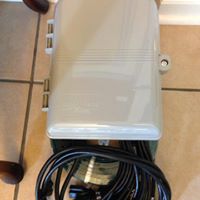
We initially used extension cords to hook everything up, but it started getting expensive as we added more channels, not to mention that they are bulky and heavy.

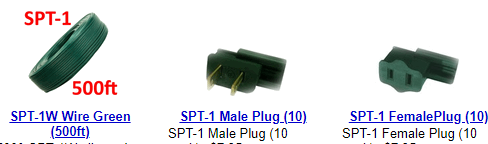
SPT1WirePlugs

We now mainly use SPT-1 wire (16-gauge speaker wire) along with vampire plugs to run power to each string of lights.

Automating the Show

Our goal, once we started using the light controllers, was that the show would be totally automated…meaning we would not need to turn it on and off every day. We also wanted to be able to have visitors be able to hear the music, but not have the music bother my neighbors.

So we added a standalone “miniDirector” to run the show and a FM transmitter.

The miniDirector has the sequences and songs saved on a SD card. When the power is turned on by the timer, the miniDirector starts running the show in a loop. It outputs the audio to the FM transmitter so viewers can hear the music right in their cars and it outputs the sequencing signals to the controller via serial connection using cat-5 cable. All the controllers are linked together in this way.

Now the show runs at the programmed time with no need to keep a separate computer running to drive it.

Well that about wraps it up for what we use to automate our holiday light show. Below are videos of some of the sequences:

Videos

This is Halloween – Full

[youtube https://www.youtube.com/watch?v=6tpE76pop3o]

Carol of the Bells – Full

[youtube https://www.youtube.com/watch?v=zzFTO-pTNug]

Dragula – Full

[youtube https://www.youtube.com/watch?v=H9ig8tNIxUc]

This is Halloween – Clip

[youtube https://www.youtube.com/watch?v=l06qcycc648?start=166]

And, as always, let me know what you think in the comments. Ask questions, tell your story.

If you like my posts, please share them with others and subscribe to this blog.

Business – We Don’t Need No Stinking Processes!…or Do We?

CreatingBusinessProcesses

Example of documenting a Business Process.


This week we are back to business basics. I am going to go over Business Processes, specifically, and why they are important to people running small businesses, better known as entrepreneurs.


Growing up, I yearned to run my own business. I was exposed to lots of people running their own businesses and it was seductive…do your own thing, be your own boss, make as much money as you wanted to (I was a poor kid and idolized the idea). But as I grew older, I would observe these various entrepreneurs’ businesses fail and disappear. Some of it was from bad financial practices, (as covered in this story: My History with Money, Pt. I), some of it was from just bad business ideas, but as I have come to realize, all of them were due to not having documented processes & systems in place to operate their business.


BusProcDef


What is a Business Process?


A Business Process is a map of the steps needed to be taken to achieve a goal or result. This can be the process for generating a price quotation or making a Big Mac. It is the set of step-by-step instructions to complete that task.


It can be as simple as the process detailed below:


PB&J


  1. Lay out 2 slices of bread
  2. Spread PB on one slice
  3. Spread Jelly of the other
  4. Put the 2 slices together to complete the PB&J Sandwich


Or it can be extremely detailed, for quality control and efficiency:


Peanut Butter and Jelly Royale


  1. Lay out 2 slices of bread that conform to the QC shape on the QC chart on the wall next to your station
  2. Evenly spread 1 oz. of premium natural peanut butter on the right slice of bread
  3. Evenly spread 1 oz of locally-sourced hand-made strawberry jelly on the left slice of bread
  4. Align the peanut buttered slice of bread over the jelly spread on the other slice of bread and lower it to complete the sandwich


But What About Systems?


Some mistakenly refer to the processes and systems interchangeably. In reality, processes are part of a system. A collection of similar processes make up the system. Let’s you are running a fast food restaurant and you want to ensure that the food presented to the customer is the same, every time. You would document a set of processes for each item on the menu, similar to the PB & J examples above. This collection of processes would be your Food Prep System. You would have a separate system for taking orders and another for inventory, and so on.


Another point about systems is that a system does not have to involve technology. There have been lots of technology systems designed to ease and automate manual systems. An easy one to bring to mind is for accounting. You have many options available for electronic accounting systems, but it is still something that could be done by hand. Not that I am advocating to accomplish your accounting by hand. In most cases, using an electronic accounting system is much more cost-effective than doing your accounting by hand. In our real estate rental business, the accounting is handled using a Google Docs spreadsheet, because the complexity of what we are doing and the time it takes to do it does not yet justify actually paying for an electronic system.


Why do I Need Business Processes?


You may ask yourself “Why do I need business processes?” Well, if you are a sole proprietor, who plans to never expand, hire personnel, step back from working in the business, or sell the business, then you probably don’t need to worry about business processes. Even though you are most likely following business processes already, if the above description fits you, you can probably get away with not documenting your business processes.


If you don’t fit the description above, these are the main reason to document your processes:


Precision and Consistency – You want to ensure that things are being done the same way every time. Borrowing from the Peanut Butter and Jelly Royale example above, if you don’t specify how much of each material to use, then you are left with each order resulting in varying quality AND cost to you as the business owner or operator. While using more peanut butter on a sandwich sometimes seems like a small thing that can be overlooked, it affects your Cost Of Goods Sold (COGS) for that sandwich, and throws off your inventory, which could result in your running out of peanut butter before your next order. This could affect your sales of the Peanut Butter and Jelly Royale until you get more product in.


Even if you are able to go out and source a spot supply of peanut butter, it will most likely further impact your cost.

**For the purposes of this example, the peanut butter sandwich and it’s ingredients are a metaphor for whatever you happen to sell in your business**


Redundancy – It is a good idea to document business processes as a kind of back-up. The reasoning behind this relies on the “Hit By A Bus” theory…If the business process is not documented, how would someone else be able to accomplish the task if the person(s) who know how to do it should get hit by a bus?


Efficiency – By having the detailed steps laid out in a business process, there is less chance of deviation of how to accomplish the task, allowing it to be completed faster. The caveat to this is that the process must already be efficient. One way to ensure efficiency is to review processes periodically to make sure they are the optimal way to achieve the task.


Scalability – Another reason you need to have documented Business Processes is to achieve scalability. Let’s say your company builds a widget and you have an opportunity to lock down a sales contract to deliver 25 widgets a month. Your business historically has only delivered a maximum of 10 widgets a month. How do you scale up your business to be able to produce 150% more product? By bringing in more employees. How do you train the new employees to be able to accomplish those tasks? By having detailed Business Processes for you Widget Production System so that employees can get up to speed faster on how to do their job and allow you to produce that increase in widgets almost immediately.


I hope I have been able to make a compelling case for why you need to have documented Business Processes and helped you to understand how it can help your business.


Here is some recommended reading on Business Processes:


4 Simple Steps to Developing Business Systems

https://www.growthink.com/content/4-simple-steps-developing-business-systems


The E-Myth Revisited: Why Most Small Businesses Don’t Work and What to Do About It

https://smile.amazon.com/dp/B000RO9VJK/ref=cm_sw_r_tw_dp_U_x_15roBbX10PDC6


And, as always, let me know what you think in the comments. Ask questions, tell your story.


If you like my posts, please share them with others and subscribe to this blog.

REI: Getting Out of a REI Deal

Escape-Contract-Reject

Contract Contingencies or “loopholes” can help you get out of a bad deal.


This week I am going to go over how you can be protected by contingency clauses in your purchase agreement contract, specifically from an investment perspective.

Purchase Agreement Loopholes

When you sign a standard real estate purchase agreement, you have the option to include contingencies, to protect you and allow you to get out of the agreement. You can include a financing contingency, (if you need to get approved for financing), a title contingency, (in the event the title is not “clear”, in merchantable condition, and the seller cannot remedy it), sale of another property, appraisal price being equal to or greater than the sale price, no issues found during an inspection period, or pretty much any other contingency you would like to include.

The key thing to remember is that the seller has to accept these contingencies. The specific ones listed above are standard contingencies and sellers are used to seeing them. As a real estate investor, you should know that the number of contingencies could possibly affect the seller’s decision to accept your offer if there is a similar offer for the property with less contingencies.

The main contingencies to include are the inspection period and clear title.
You should have your financing in place already, to make the deal go smoothly. This can be personal cash, private money, hard money, or being pre-qualified for a loan from a traditional lending institution.
In selecting your properties, you should have a pretty good idea of the market value of the property and in pursuing the target property, have negotiated a sale price that is discounted from market price, allowing you to cover expenses and cash flow.

Utilizing a Contingency

A couple of weeks ago, I posted about making an offer on an REO property. I was excited for the opportunity to acquire this property because it was in the same neighborhood as the last property we acquired and had a couple of more amenities.

We were at the point of waiting for the asset manager to respond with the final signed contract so we could start the inspection period. We waited and waited…but did not hear anything for a whole week.
We were told to expect up to a seven day wait for a response, but when we finally did get a response on the ninth day after we submitted contract signatures, the asset manager had signed the contract two days after we submitted it. This left us with approximately two and a half days for inspections, title search, etc., and late on a Friday morning. There was no way we would have been able to get the title search completed at that point.

We exercised the contingency and canceled the contract.

Because of issues like this, I am glad I had the option to exit the deal. Some investors may not worry about the title, but I do. I have run into title issues in the past that made it hard for me to sell a property, so I wanted to be sure that the title was clear. Especially with the property being an REO property.

With it having been through a Sheriff’s Sale, the title “should” be cleared of all liens, but if a lienholder was not notified that the property was going up for Sheriff’s Sale, then their lien is still in effect.

I could have run the title search before getting confirmation that we had a contract in place but did not want to spend $500 and not be able to get the property under contract.

So, on with the property search!

Oh, if you are in the Houma/Thibodaux area and have property you need to sell, get in touch with me.

And, as always, let me know what you think in the comments. Ask questions, tell your story.

If you like my posts, please share them with others and subscribe to this blog.

Personal Improvement – How Do You Spend Your Time?

This week I am going to talk about how you send you time and how it affects progress towards goals. This is a topic that keeps coming up (for me) from various sources and every time it does, I get more of an urge to discuss this topic here. So…here we go.
“How do you spend your time?”
Ask that question of a hundred different people and you are likely to get a hundred different answers. Some people may list every detail, others may just give a twenty-thousand-foot overview.
  • Successful people have goals.
  • Successful people have a plan to reach those goals.
  • Successful people follow a process and their processes are habits.


Observations of Others
In a recent blog post, Dave Van Horn talks about a speaker at a recent investing summit who asked the question “What would you do if you were a billionaire?”
The answers were some form of the three below:
  • “I would travel more.”
  • “I would focus on my passion.”
  • “I would give to charity.”


Dave then goes on to point out that “billionaire” status is not needed to achieve these goals, as evidenced by the speaker, (not a billionaire), only that you budget your time as you do your money to its best possible use. Don’t waste your time doing things that won’t move you forward. You can pay someone to take care of that for you if your time would be better spent being effective.
He then relates how Tony Robbins asks similar questions:
  • What is an extraordinary life for you? – Hopefully this is something that you can achieve in the next six to twelve months.
  • What is preventing this from happening already? – What story do you give as an excuse for not having achieved it already?
  • What needs to change now? – This brings it back to taking action.


This may sound familiar. It is similar to what I outlined in how to resolve overspending.


Once you have set a goal, identified what is stopping you from achieving that goal, and put a plan in place to change things your goal, things may still not happen perfectly.

Life will always throw you curveballs. Our initial reaction is to get emotional and point to all the reasons why we are failures. We can come up with lots of feelings on the subject, but in reality, over the long term, they don’t make much of a difference in the long run. Life goes on.
The way we can get through this is to put it in perspective. Learn from failure. Defeat your emotions with logic. What important things are you missing because you choose to worry versus logically evaluating the facts? Just because you are in control of your emotions does not mean you don’t feel them, just that you are taking care of business so you can deal with your emotions at an appropriate time.
By thinking clearly rather than getting caught up in emotions, General Eisenhower, in WW2, was able to determine a way to defeat the German Blitzkrieg, a battlefield strategy that involved throwing everything they had at the allied forces in a single attack. It was scary and worked in lots of battles, with allied forces so surprised, shocked, and overwhelmed by the speed and ferocity of the attack, that they just gave up.
General Eisenhower realized that the Germans were putting everything they had into the attack, leaving their flanks and rear unprotected. His approach let the Germans attack, but held groups back to flank the German attack, thus surrounding & defeating them.
Here are some quotes that reflect this approach that I find helpful:

“What doesn’t kill you, only makes you stronger!” – Jean-Baptiste Emmanuel Zorg (Antagonist from The Fifth Element)

 He wasn’t the originator but is as good an attribution as any. This means that you learn from your mistakes. Dealing with difficulty helps you to become more resilient, more anti-fragile.

“I must not fear. Fear is the mind-killer. Fear is the little-death that brings total obliteration. I will face my fear. I will permit it to pass over me and through me. And when it has gone past I will turn the inner eye to see its path. Where the fear has gone there will be nothing. Only I will remain.” – Frank Herbert, from the book Dune. 

 It is OK to be scared, but don’t run from it. Face your fears. Once you face your fears, they have little power over you.

“Our actions may be impeded, but there can be no impeding our intentions or dispositions. Because we can accommodate and adapt. The mind adapts and converts to its own purposes the obstacle to our acting. The impediment to action advances action. What stands in the way becomes the way. – Marcus Aurelius – Holiday, Ryan. The Obstacle Is the Way: The Timeless Art of Turning Trials into Triumph (p. 1). Penguin Publishing Group. Kindle Edition.


This is similar to the “What doesn’t kill you” quote but goes a little deeper and touches on something that doesn’t seem common these days…the idea that by facing hardship, you grow. In fact, it is the reason for the title of Ryan’s book, “The Obstacle is the way”.

Do the uncomfortable things, if it will further your goals.
Grow from those experiences, so that next time, you either know how to handle it already, or if it is a big issue, avoid it altogether.
Learn from mistakes.
Budget your time.
Budget your money.
Grow, as a person and as a leader.
And, as always, let me know what you think in the comments. Ask questions, tell your story.
If you like my posts, please share them with others and subscribe to this blog.

REI – Buying a Property While on Vacation

Yes, you can legally sign digital documents from your phone!
Today I am going to go over how we negotiated a purchase agreement for a new rental property while we were on vacation. I will summarize how it can be done and why you shouldn’t sit around waiting for something.
REO? (Not Speedwagon)
Part of my process for finding properties is to have searches set up on the various real estate websites such as Trulia, Zillow, and Realtor. They send me emails on a daily basis with local properties in my areas of interest that meet my investing criteria. I noticed that there was an REO property up the street from the last property we purchased. REO is Real Estate Owned and means that it is a property that the bank has foreclosed on and wants to get off of it’s books, hopefully recouping the money they have into it.
This property had been foreclosed on by the bank and sold at a Sheriff’s Sale back to the bank at some point prior to February of this year.  They then listed it for $98,800. About six weeks later, they dropped the price to $89,900. A month later, it was $79,900. Then they ramped it back up to $98,800 after 6 weeks, but dropped it to $79,900 about 5 days later, so it must have been a typo. And roughly two weeks after that, they dropped the price, again, to $69,900.
It was at this point that we decided to go look at it. There was no power or water service connected, so we couldn’t inspect the plumbing or electrical functionality, but we were able to look at everything.
The property apparently had doors and paint updated in recent years. The floors were mostly tile throughout, with real parquet wood floors in two of the bedrooms and damaged/improperly installed laminate flooring in the master suite. The back exterior will need a little attention along with the roof, but all in all, the property appears to be in good shape and not needing as much in rehab as our last acquisition.
The Rub
The day we looked at the property was the day before we were leaving for the week to go on vacation out of state. We did not have time in our schedule to travel to the realtor’s office and sign paperwork. Luckily, we did not have to. The offer was submitted online via a secured signing portal.
All further counter-offers were done in a similar manner either from my phone or laptop, allowing us to enjoy our vacation and still take care of business on our schedule.
We are currently waiting on the “paperwork”, but we have come to an agreement on price and are waiting for the start of the due diligence process, where we get the property inspected and look for any deal-breakers.
I will detail the whole deal in a future post, once the deal is complete and the  property is rehabbed and rented.
And, as always, let me know what you think in the comments. Ask questions, tell your story.

If you like my posts, please share them with others and subscribe to this blog.

Business Finance – Understanding Cash Flow

An infographic representation of Cash Flow.


Today I want to go over Cash Flow and why it is critical to business finance.
There are four basic reporting metrics for business finance:
  • Balance Sheet – Statement of financial position, reporting a company’s assets, liabilities, and owners’ equity at a given point in time.
  • Income Statement – Statement of revenue and expense or profit & loss.
  • Equity Statement – Statement of changes in equity or retained earnings.
  • Cash Flow Statement – Statement of a company’s cash inflows and outflows during a given period of time.


I will cover the first three in more detail with later posts because I want to talk about Cash Flow and the Cash Flow statement.


Cash Flow
Cash Flow is the total amount of money coming into a business (revenue, income, investments, loans, etc.) and the total amount of money going out of a business (bills, expenses, wages, capital purchases, etc.) over a given period of time. It can be a year, a quarter, a month, or any time period you want to look at. For my purposes, monthly reporting is preferred, as it coincides with other regular monthly financial reports.
Doesn’t the profit & loss report show you the same information?
While reporting similar information, Cash Flow & Profit & Loss Reports serve different purposes. The Cash Flow report gives you an understanding of how you are bringing money into your business and how you are spending it while the P & L report shows you revenue earned and expenses paid.
OK, that still sounds similar, you say.
It may be easier to understand if you look at it from the perspective of different accounting methods. Businesses use either the Cash Basis or the Accrual Basis methods.

“Cash basis – Revenue is recorded when cash is received from customers, and expenses are recorded when cash is paid to suppliers and employees.


Accrual basis – Revenue is recorded when earned and expenses are recorded when consumed.”

If you are operating on the Cash Basis method, your revenue and expenses are recorded into your accounting system when they occur. In this case, your P & L and Cash Flow Reports should show almost the same information for a given period, with minor differences like loan principle repayments not showing up on a P & L.
In the case of the Accrual Method, you might earn revenue in a given month, but you won’t see the money from it until the invoice gets paid, which may be a month down the line. As for expenses, you may be paying for supplies immediately, but can’t show them on the P & L until the revenue is earned. So, you are potentially paying for supplies in one month, showing revenue in the next month, and not actually getting paid until the third month.  In this scenario, the P & L would show the expense & revenue in the second month, but the Cash Flow would show the outflow of the expense in the first month, no activity (with respect to the subject order) in the second month, and would show the revenue inflow (invoice being paid) in the third month.
Because of this, you should be looking at both reports to better understand what is going on in the business.
Why is Cash Flow important?
 
To be a successful business, you want to have positive cash flow…that means that you have more money coming in every month than you are paying out in expenses, wages, and bills. This seems like a “DUH!!!” statement, but without looking at both your P & L AND Cash Flow reports, it would be hard to make sure you are able to bring in more cash than pay out in expenses.
Without regularly reviewing the Cash Flow statement, you might think you are breaking even or close to it, until you realize that your bank account has steadily been dropping and you really were not even close to breaking even.
And, as always, let me know what you think in the comments. Ask questions, tell your story.
If you like my posts, please share them with others and subscribe to this blog.
Verified by MonsterInsights